Our Model for Making Everyday Justice Happen
At BIHR we believe that human rights are tools for real-world change. We don’t litigate in courts. We work on the ground. We don’t offer legal advice. We build capacity. We don’t campaign for new laws without implementation. We make existing laws work.
BIHR uses the strategic implementation of the Human Rights Act (HRA) to secure everyday justice.
We support people, communities, civil society, and public bodies to put human rights into practice. By using evidence from real-life experiences and HRA advocacy, we help improve decisions, strengthen services, and drive wider reform. Rather than focusing on individual cases in isolation, we use what happens in practice to identify wider barriers and opportunities for change.
We work across three connected levels:
Immediate Justice: Using the Human Rights Act to challenge poor decisions and secure better outcomes in people's lives.
Institutional Practice: Embedding human rights in public services, decision-making, and accountability.
Systems Reform: Influencing law, policy, and systems through evidence from human rights in practice.
These three levels reinforce one another in a continuous cycle of learning, action, and change.
Human Rights Act knowledge & confidence →
Human Rights Act advocacy and action →
Human Rights Act-informed decisions and services →
Human Rights Act-informed systems change →
Everyday justice
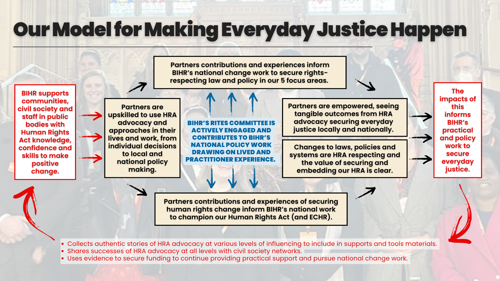
We build people's knowledge, confidence, and skills to use the HRA in practice. People and organisations use human rights to challenge poor decisions, influence the decisions that affect them, and secure positive change in their communities and services.
The experiences, evidence, and learning generated through this work inform BIHR's national role in two ways: shaping our practical and policy work across our five key areas, and strengthening our work to champion and protect the Human Rights Act and European Convention on Human Rights.
By connecting learning across communities, civil society, and public bodies, we identify shared challenges, effective solutions, and opportunities for wider reform.
In turn, people, communities, and public bodies see tangible outcomes from using the HRA: better decisions, better services, stronger policies, and stronger systems.
These outcomes help secure everyday justice locally and nationally, while generating new evidence and learning that informs the next cycle of action.
Our RITES Committee
Throughout, BIHR's RITES Committee contributes lived and practitioner experience directly to our national policy and influencing work. The Committee brings together people with direct experience of real rights issues in their lives, communities, and work. It helps ensure our priorities, policy positions, and practical solutions are grounded in the realities of using the Human Rights Act in practice.
